
Learning Pharmaceutics from YouTube: A Valuable Tool for Undergraduate Students
-
By Asra Awabeen
Objective: Pharmaceutics is a crucial subject in pharmacy education, covering the principles of drug formulation, delivery, and stability. Traditional teaching methodologies, including lectures and laboratory experiments, have long been the cornerstone of education. However, the digital revolution has introduced alternative learning approaches, such as online video platforms. YouTube has emerged as a widely used supplementary educational resource due to its accessibility, visual appeal, and engaging content. This study explores the role of YouTube in learning pharmaceutics among undergraduate students, analyzing its effectiveness, student preferences, and limitations. Materials and Methods: A cross-sectional study was conducted among pharmacy students using an online survey to assess their use of YouTube for learning pharmaceutics. Results: The results indicate that a majority of students rely on YouTube for concept reinforcement, particularly for complex topics such as drug formulation and biopharmaceutics. While students appreciate the accessibility and clarity provided by YouTube videos, concerns regarding content credibility and lack of structured learning pathways remain. Conclusion: The study concludes that YouTube is a valuable tool in pharmacy education but should be used in conjunction with verified resources and instructor guidance.
Read More
Assessment of Pain Symptoms in Primary Care Physiotherapy: Insights from Patient-Reported Data
-
Abstract Introduction Musculoskeletal (MSK) pain is a leading cause of disability, significantly affecting quality of life and work productivity. Many individuals initially rely on self-medication and home remedies, leading to delayed physiotherapy intervention. Understanding patient-reported pain characteristics is essential for optimizing physiotherapy management strategies. This study aims to analyze pain distribution, intensity, symptom duration, and recurrence among patients seeking primary care physiotherapy. Methods A cross-sectional observational study was conducted across primary care physiotherapy clinics in the Middle East, using a systematic random sampling approach. Data from 1,600 patients were collected via validated self-reported questionnaires before their initial consultation. Pain characteristics, including primary symptom site, co-occurring pain sites, intensity (0–10 Numeric Rating Scale), symptom duration, and recurrence, were analyzed. Descriptive and inferential statistics, including multivariate logistic regression, were used to identify predictors of chronic pain. Results The lower back (38.5%) was the most common primary symptom site, followed by the knee (22.1%) and shoulder (14.3%). Co-occurring pain was reported in 47.8% of cases. The mean pain intensity was 6.7 (SD = 1.9), with 50.4% experiencing chronic pain (>12 weeks). Higher pain intensity (OR = 2.3, p < 0.001) and multiple pain sites (OR = 1.9, p < 0.001) were significant predictors of chronic pain. Conclusion MSK pain is highly prevalent, with many patients experiencing chronic and recurrent symptoms. Early physiotherapy intervention should be prioritized for individuals with high pain intensity and multisite pain to prevent long-term disability. Future research should explore multifactorial contributors and assess treatment efficacy in physiotherapy settings. Keywords: chronic; data; experience; muscle; skeleton
Read More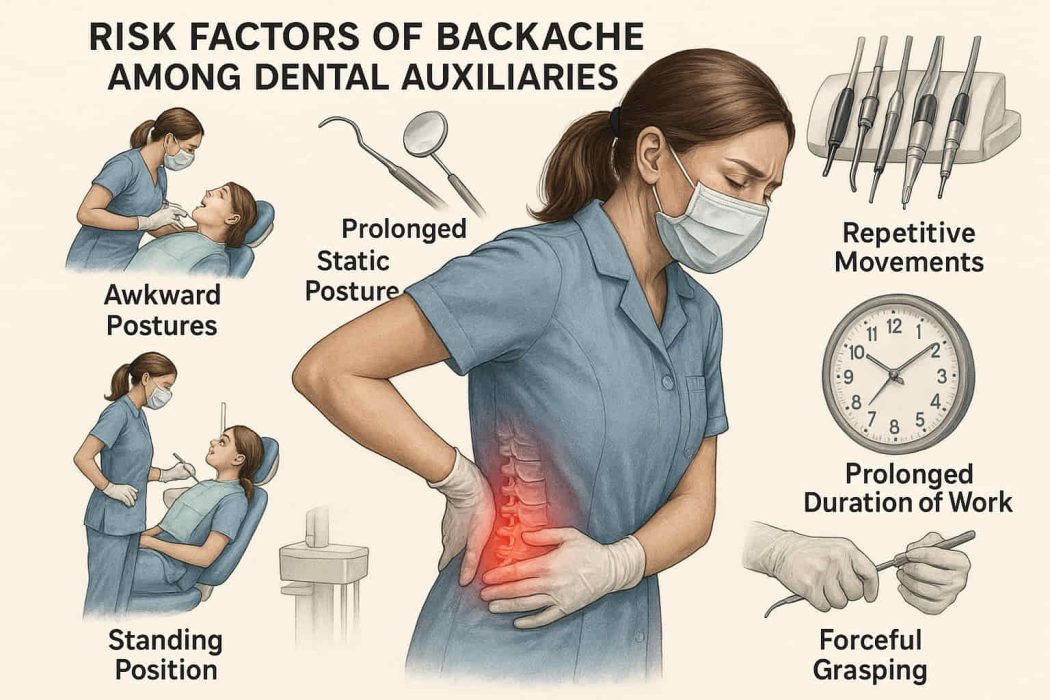
Prevalence and Risk Factors of Backache Among Dental Auxiliaries: A Cross-Sectional Study
-
Background: Occupational health issues, particularly musculoskeletal disorders (MSDs), are prevalent worldwide. Dental auxiliaries are prone to backache due to prolonged static postures and repetitive movements, affecting their productivity and quality of life. Objective: To determine the prevalence of backache among dental auxiliaries in Islamabad and Rawalpindi and analyze the associated risk factors. Methods: A cross-sectional study was conducted using a self-administered, validated questionnaire distributed among 80 dental auxiliaries in hospitals and private clinics. The variables assessed included work posture, specialty, working hours, years in practice, and absenteeism due to pain. Data were analyzed using SPSS version 17, with chi-square tests applied to determine associations between back pain and independent variables. Results: Out of 80 distributed questionnaires, 60 (75%) were completed. Among participants, 78.3% were males and 21.7% females. The overall prevalence of back pain was 65%. Among affected participants, 58.3% reported bearable pain, 1.7% experienced severe pain, and 5% did not specify. The only factor significantly associated with back pain was specialty (endodontics/operative department, p = 0.04). Other factors, including posture, years in practice, working hours, and exercise, did not show significant associations. Conclusion: A high prevalence of back pain was observed among dental auxiliaries in Pakistan. Ergonomic interventions, targeted training, and workplace modifications are essential to mitigate occupational health risks.
Read More
Attitudes of Healthcare Students Towards Interprofessional Education
-
Interprofessional education (IPE) is increasingly recognized as crucial for effective healthcare
delivery. This study aimed to assess the perceptions of medical and nursing students in Pakistan using the Interprofessional Attitude Scale (IPAS).

Level of Empathy Amongst Undergraduate Medical and Dental Students in India: A Cross-sectional Study
-
The aim of the study is to measure the levels of empathy amongst undergraduate dental and medical
students across various universities in India, exploring factors that influence these levels to provide insights into enhancing empathy training in healthcare education.

Assessing Awareness and Knowledge of Therapeutic Communication Skills Among Nursing Students in Swat, Pakistan
-
A key element of high-quality healthcare is effective therapeutic communication between nurses and patients, which improves patient happiness, comprehension, and recovery results. The purpose of this study was to assess nursing students’ awareness and understanding of therapeutic communication at a private nursing school in Swat, Pakistan.
Read More
Prevalence of Needle Stick Injury and Associated Determinants among Healthcare Employees of Tertiary Care Hospital, Bangladesh
-
Needle stick injuries (NSIs) are a recurrent issue among healthcare employees. The study aims to evaluate the frequency of needle stick injuries and identify predisposing components at a tertiary care facility in Dhaka.
Read More
Perceptions and Educational Needs of Bangladeshi Medical and Dental Students Regarding Artificial Intelligence in Healthcare
-
The increasing prevalence of artificial intelligence (AI) technologies in the field of healthcare brings
forth diverse applications. This study explores the perceptions of undergraduate medical and dental students regarding AI, their current educational opportunities related to AI, and their preferences for the delivery medium of AI curriculum in Bangladeshi medical and dental students.

Histological Alterations in the Odontoblastic Layer of Dental Pulp After Tooth Preparation
-
This study aims to explore the histological alterations observed in the odontoblastic layer of the dental pulp following tooth preparation.
Read More
Assessment of the antimicrobial impact of Melaleuca alternifolia essential oil on Klebsiella pneumoniae strains
-
Tea tree oil (TTO) from Melaleuca alternifolia is renowned for its therapeutic properties, including antimicrobial effects. Standardized by ISO 4730:2017, TTO’s major component, terpinen-4-ol, contributes to its broad spectrum of activity. Notably, TTO demonstrates efficacy against Cutibacterium acnes, suggesting a potential role in acne treatment. In the context of Klebsiella pneumoniae (Kp), a carbapenem-resistant Gram-negative bacillus associated with pneumoniae, this study explores TTO’s antibacterial and anti-adherent activities.
Read More