From Climate Awareness to Climate Readiness: Reimagining Higher Education
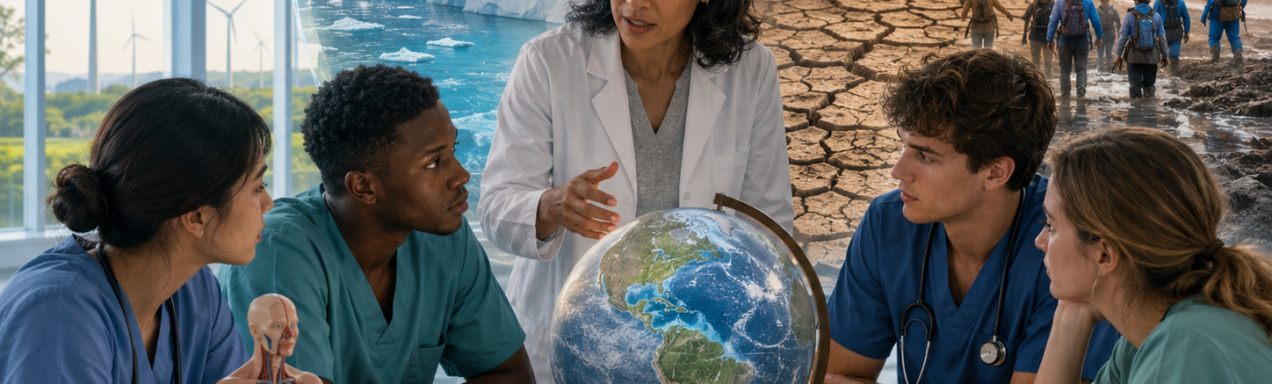
Higher education has spent decades teaching students about climate change. That is no longer enough. As heatwaves close campuses, floods damage infrastructure, droughts disrupt food and water systems, and climate anxiety shapes student life, universities must move from climate awareness to climate readiness. The central question is no longer whether graduates understand climate change, but whether institutions are preparing them, and themselves, to live, lead, and solve problems in a warming world. Climate resilience should be treated as a core mission of higher education, not as an optional sustainability project. The Intergovernmental Panel on Climate Change makes clear that climate risks are already affecting ecosystems, health, economies, and communities, and that adaptation must be accelerated alongside mitigation.1 Universities are uniquely positioned to answer this challenge because they educate future professionals, produce knowledge, manage large physical campuses, and often serve as trusted civic anchors. Their influence extends far beyond lecture halls. The first transformation must happen in the curriculum. Climate education cannot remain confined to environmental science courses.2 Engineers need to design infrastructure for extreme weather. Health students need to understand heat stress, disease shifts, and disaster response. Business students need to evaluate climate risk and just transitions. Teachers need tools to help young people understand uncertainty without despair. Artists and communicators need to translate data into public meaning. Research on sustainability education emphasizes systems thinking, anticipatory thinking, values-based reasoning, collaboration, and action-oriented problem solving as essential graduate capacities.3,4 In short, every discipline has a climate dimension. The second transformation must happen on campus. A university that teaches resilience but ignores its own vulnerability sends the wrong lesson. Campuses should become living laboratories for climate adaptation: mapping flood risk, redesigning buildings for heat, expanding green spaces, reducing emissions, protecting biodiversity, improving water systems, and ensuring continuity of learning during disasters. This approach links knowledge with practice and gives students authentic problems to solve. It also shifts sustainability from branding to institutional accountability. The third transformation must happen through community partnership. Climate resilience is place-based. A coastal university, an urban university, and a rural university face different risks and responsibilities. Institutions should work with local governments, schools, Indigenous communities, health systems, farmers, and civil society to co-create solutions. This matters because climate impacts are unequal. Students and communities with fewer resources often experience disruption first and recover last. A resilient university must therefore be a just university. Reimagining higher education for climate resilience requires leadership. It means embedding climate risk into accreditation, budgets, infrastructure planning, research funding, procurement, and student support. It means measuring success not only by publications and rankings, but by preparedness, public value, and social transformation. Climate awareness helped universities name the crisis. Climate readiness will determine whether they are worthy of the future they claim to serve.

Global Challenges of Enteric Fever: Gaps, Hurdles, and Hope
Enteric fever, caused by Salmonella enterica serovars Typhi and Paratyphi, remains a pressing global health challenge. This guest editorial outlines the gaps in diagnosis, the spread of multidrug-resistant strains, and the hurdles and hopes for prevention and control.

None of Us Is as Smart as All of Us
Imagine Mrs. XYZ, a 69-year-old woman living in a remote area with her son’s family. One evening, she was brought to the hospital after a minor fall. Upon examination, her blood pressure was low, and she had a small fracture in her hip. The medical doctor admitted her for observation and pain management. During her care, the nurse noticed she seemed more confused than expected. During a medication review, the pharmacist realized she was taking two different medications prescribed by different doctors for the same condition, which were lowering her blood pressure, which might have led to the fall. A physiotherapist noticed that her muscle strength was poor for her age and suspected early frailty. The public health specialist spoke with her family and found out that Mrs. XYZ had a sedentary lifestyle with poor eating habits. The psychologist uncovered that she was grieving her husband’s recent death and suffering from undiagnosed depression. She was feeling like a burden to her family. If all these professionals had not spoken up or only worked in silos, Mrs. XYZ would’ve been discharged as ‘stable’, only to return weeks later with a major depressive episode, a serious injury or even something irreversible.

Novel Biomarkers for the Early Detection of Myocardial Infarction
Early detection of myocardial infarction (MI) is essential, yet traditional biomarkers like Troponin and CK-MB have limited sensitivity in the initial hours after symptom onset. Emerging biomarkers such as miRNA-208, miRNA-499, and Copeptin show promise for earlier diagnosis, particularly within the first 3 hours. Additionally, markers like GDF-15, sST2, suPAR, H-FABP, sLOX-1, and various RNAs (including N1LR, SNHG1, TTTY15, and HULC) offer potential for improved MI detection and prognostic assessment. Integrating these novel biomarkers could enhance early diagnosis and management of MI, ultimately leading to better patient outcomes.